BuiltWithNOF
Bannack State Park

6/13

In spite of the heavy clouds, we head for Bannack State Park about 30 miles from here.  After leaving I15 we were driving through a flat valley with high desert brush & grasses that had a number of large cattle ranches and some small settlements as we slowly ascended into foothills that became mountains before too long.  All deliciously green.  Ghostly Bannack State Park is the remains of the townsite of Bannack, named for the Bannock Indians who lived nearby.  It was founded in 1862 when John White & a group of fellow Colorado folks discovered gold in Willards Creek.  Not knowing that Lewis & Clark had named that creek, John named it Grasshopper Creek, a name it is still known by today.  He filed one of the first mining claims in the Territory of Montana.  400 folks called Bannack home by the fall and in the spring 3,000 people were living there.  Bannack eventually became the capital of the Territory.  Its existence depended on the gold pulled out of the placer deposits.  As time passed there was a decline in mining & people had to go elsewhere to look for work.  In the late forties the majority of the population had moved to other areas.  The post office left in 1938 & the school was closed in the 1950s.  There was no doctor & no grocery store.  Through a series of actions taken by locals & people in Dillon, the land was eventually donated to the state in 1954, with the stipulation that Bannack was not to made into a tourist town to compete with Virginia City, then & now a very popular tourist attraction about 60 miles away.  The ghost town atmosphere was to be preserved.  The state made additional land purchases to complete the townsite.  A boardwalk takes you from building to building.  Most are open for your enjoyment.  We went on a bad weather day on a Monday so the Park was virtually deserted.  As we walked the boardwalk, looking at the empty buildings with the mountains framing them, it did feel ghostly.  I expected to have people emerge from the nearby trees to continue on with the life that must have been.  This is a town with a sheriff who had done time in San Quentin for manslaughter.  He would later lead a group known as ‘The Innocents’, who were in fact criminals. Their supposed crimes were many & included murder.  The vigilante group in Bannack, formed to be the law after tiring of the sheriff & his merry men’s antics, arranged hangings for some of the men they could catch.  Virginia City had also formed a vigilante group, which managed to capture more of  ‘The Innocents’ & with some rope & beam, took care of them.  The high drama wasn’t the only thing happening in Bannock.  They had social events such as balls.  The ratio of women to men was 1- to 10, so the gals got to dance their legs off.  There was a baseball team considered to be very good   They would play teams from nearby towns. We did enjoy this very much.  It was a cold day with intermittent rain.  We dodged the rain & ate our picnic lunch in the truck with the heater going.  After warming up we went back out to complete our tour. Stabilization of the buildings is ongoing as they preserve what is there, not restore.

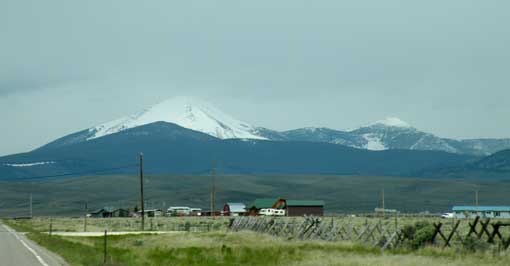
Lots of ranches and, once in a while, a small settlement of homes, on our way to Bannack State Park about 25 miles south of Dillon.

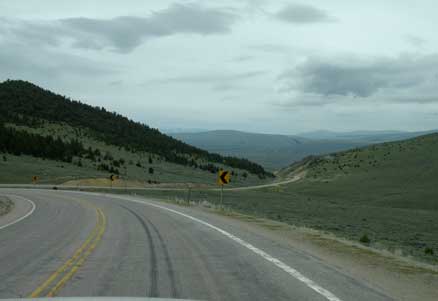
Miles of open land with grazing cattle eating lots of very green grass. There are signs of a forest fire that went through this area about 2000.  The road leaves the flat valley to cut through mountain after mountain.

The town of Bannack was built as the gold rush began & continued here.  See story above to explain the history of this wonderful place.

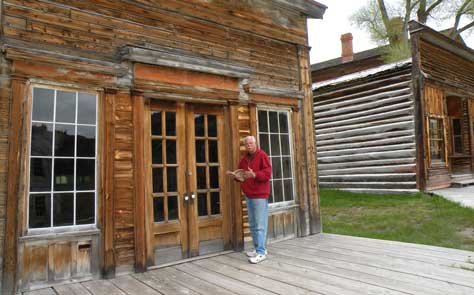
Gary looks at the handbook as he figures out what part this building played in the life of Bannack.

The town needed a school & the Masons needed a meeting place. The Masons built this large building.  They used the top floor & donated the main floor for the schoolhouse. An outside stairwell provided access to their meeting hall.  The floor & ceiling were double thick to ‘prevent the school childrens’ noise from bothering the Masons’. Hmmm.  Methinks it was the other way ‘round.

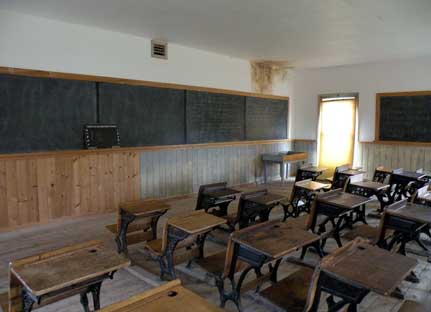
Above: At the roof’s peak there is a board carved with the Mason’s logo.  That board was a local woman’s bread-making board.  She donated it to them.  There’s got to be more to that story. The classroom was large & so was the blackboard.  We could just see the instructions written for each grade. It would take a whole wall.

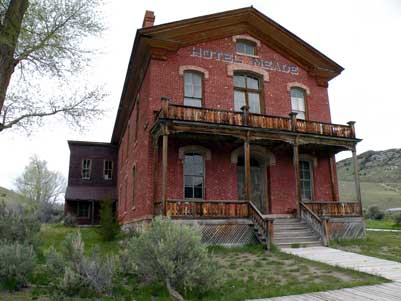
The Hotel Meade started as the county courthouse.  Built in 1875, the battle between Dillon & Bannack ended with the county seat being moved to Dillon in 1881.  In 1890 the soon-to-be hotel was bought for $1,250. (Cost the county $14,000 to build 15 years prior. Sound like our government at work?)  It was extensively remodeled & operated off & on as a hotel until the 1940’s.

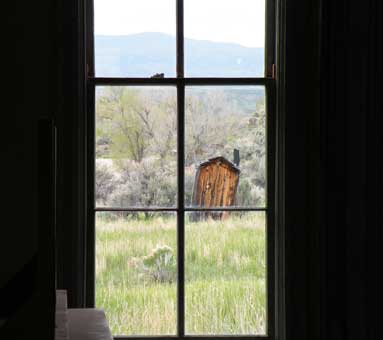
The antique, original glass in a hotel window gives a wavy view of the outhouse out back.

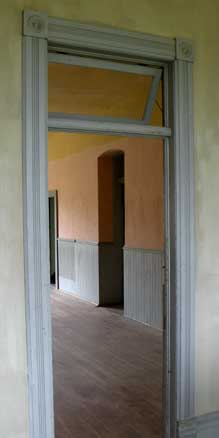
The transom windows of the doorways assured some air flow.  Still in place after all these years.

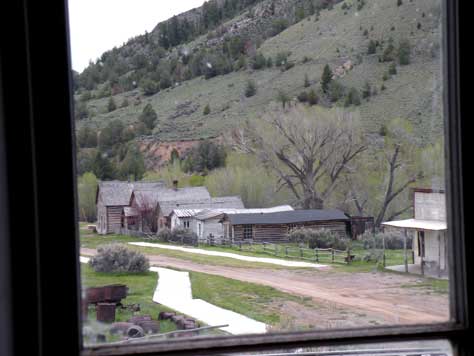
Doesn’t show up in the pictures, but this is a wavy glass view from a 2nd story room’s windows.

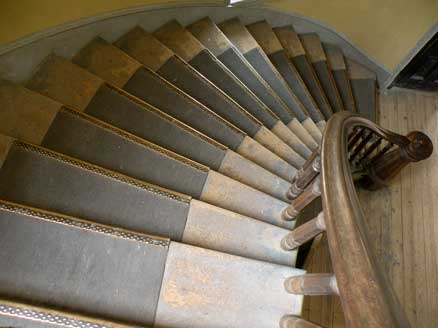
The interesting staircase from the front door area to the 2nd floor.  Of course, I took the picture from the 2nd floor looking down.

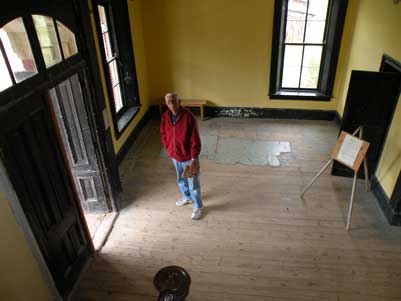
Gary standing in the entry area of the old hotel. To your right there is a black door.  That is actually a walk-in safe.

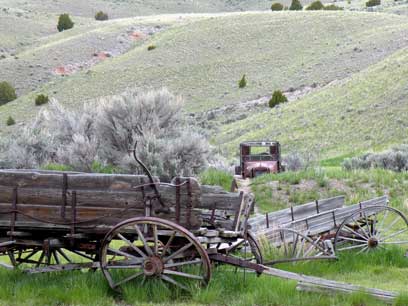
Transportation changed dramatically over the Bannack years. This ‘junkyard’ has the remains of a car as well as wagons in stages of disrepair.

A chipmunk enjoys a snack on the boardwalk and was not going to move just because we were approaching.

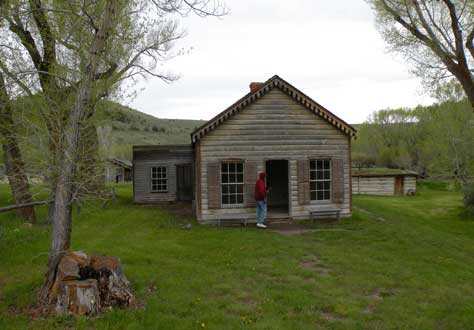
This was the site of the first governor’s mansion.  There were several small buildings on the property.  Nothing that could be called a mansion.  Turns out a twist of fate had the family here for awhile & he used one of the outbuildings as his office while here.  It became known as the Governor’s Mansion as a joke.

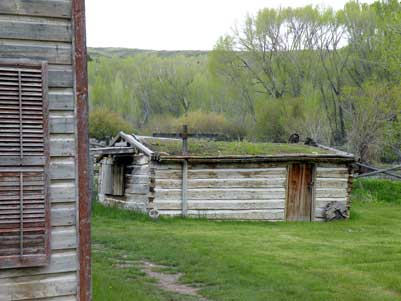
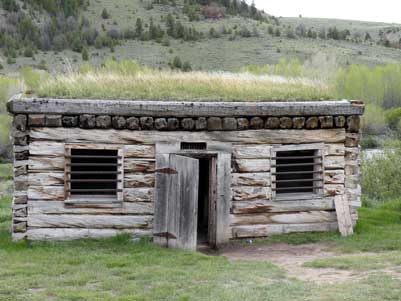
A soddy (building with dirt & grass for a roof) is seen here next to the ‘governor’s mansion’.

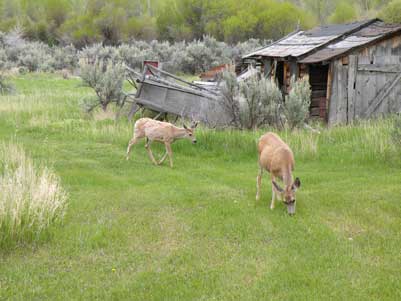
As we’re poking around & in the buildings, the deer are poking around the rich grasses.

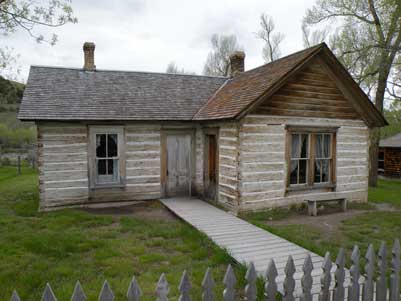
One of the last doctors in Bannack, Dr. Ryburn practiced here from 1897 to 1915.  The house has two front doors, so am assuming one door opened to his office.  He traveled extensively to treat his patients & was the first person in town to have an automobile.  Side note:  The first female practicing physician in Montana had her practice here.

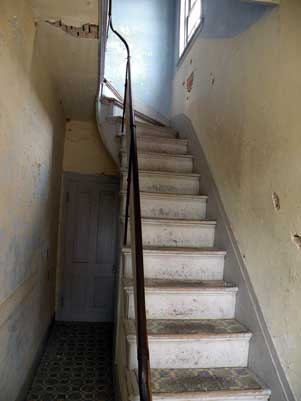
A staircase in a boarding house in town. The door under the staircase opened to what appears to be a dining room or sitting room.  The wall on the left has the kitchen on the other side of it.

The notorious Sheriff Plummer, himself a crook, had this jail built.  No one had wanted a jail before because they didn’t want to stop hunting for gold to watch over prisoners.  They would let the criminal go with stern warnings or they would simply hang the criminal.

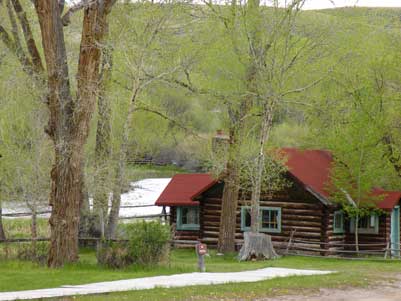
Sitting alongside a very swollen Grasshopper Creek, this sweet cabin was part of the group of buildings described as the ‘Governor’s Mansion. The creek is out of it’s bounds nearby.  A small levee is keeping the water from running through the yard.

(c) Lanesroadhouse is a copyrighted web site.  No reproduction of copy or pictures without express written consent.

[Lanes Roadhouse] [On The Road Again] [Provo,UT] [Provo, con't] [Farewell to Provo] [Hello Dillon, MT] [Dillon and Pitt] [Around Dillon] [Bannack State Park] [Fishing /n Stuff] [Traveling to Philipsburg, MT] [Philipsburg Up Close] [Pintler Scenic Drive] [Miners - Cons - Actors] [Destination Kalispell, MT] [Geese - Goats - Flotsam] [Canada-Geese,Girls,Pals] [Kalispell to Glacier] [History, Market & West Glacier] [Farmland - Campground] [Missoula, MT] [Missoula  con't] [Big Timber  Intro] [Around Big Timber] [Archive Home]